

A side-by-side comparison of Sicily and Sardinia covering beaches, culture, food, cost and the best time to visit, to help you pick the right Italian island for your trip.
Italy has two islands large enough to be their own countries, and choosing between them stops most trip plans in their tracks. Sicily covers roughly 25,700 km² and Sardinia around 24,000 km², yet the two feel worlds apart: one built on layered history and street food, the other on wild coastline and quiet.
This guide compares Sicily or Sardinia section by section, beaches, culture, food, cost, timing and traveller type, with real comparisons and traveller feedback throughout.
If you're ready to look at places to stay, you can also compare hotels in Sicily and in Sardinia once you've settled on a direction.
Sicily or Sardinia at a Glance
Sicily | Sardinia | |
|---|---|---|
Size | ~25,700 km² (largest Italian island) | ~24,000 km² (second-largest) |
Known for | Greek temples, baroque towns, Mount Etna, street food | White-sand coves, nuraghi ruins, Costa Smeralda |
Best for | Culture, food, city-hopping | Beaches, quiet, nature, luxury coast |
Getting between them | 1-hour direct flight or 12-hour overnight ferry to Cagliari | Same routes, reverse direction |
Typical daily budget | Around €75-170 on a budget trip, up to €380+ for luxury | Around €100-250 per person, higher on the Costa Smeralda |
Main airports | Palermo, Catania | Cagliari, Olbia, Alghero |
Which Is Bigger, Sicily or Sardinia?
Sicily is the bigger of the two, at around 25,700 km² against Sardinia's 24,000 km², which also makes it Italy's largest island overall.
The gap is not huge on a map, but it shows up on the ground: Sicily packs several distinct regions, from the volcanic east around Mount Etna to the baroque southeast, into a single loop that's realistic to cover in ten days.
Sardinia's extra emptiness is part of its appeal rather than a downside, with long stretches of its 1,800 km coastline still undeveloped even in August.
Our pick: if you want to feel like you've “covered” an island in one trip, Sicily's smaller footprint helps. Travellers who've done both often say Sardinia's size only becomes a problem when they underestimate driving distances between the coast and the interior.
Sardinia or Sicily for Beaches?
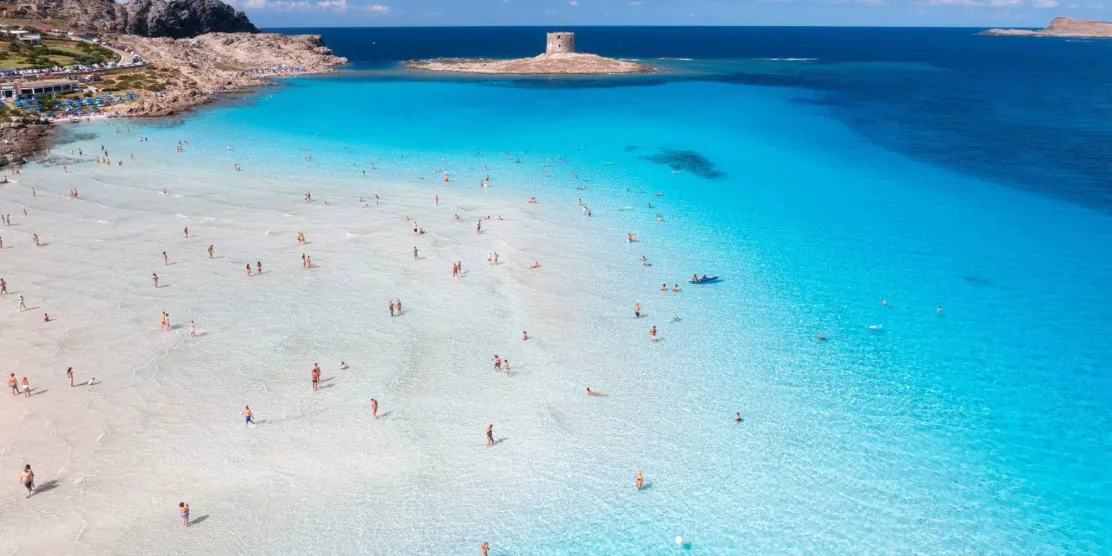
Sardinia is the one most people picture when they think “Italian beach holiday,” and the comparison holds up.
The east coast's Golfo di Orosei hides bays such as Cala Mariolu that are only reachable on foot or by boat, while La Pelosa in the northwest has the kind of shallow, pale turquoise water usually associated with the Caribbean.
Further north, La Maddalena's pink granite islets add a different texture, and Costa Smeralda's Spiaggia del Principe is the polished, high-end version of the same idea.
Cefalù combines a genuine sandy beach with a working old town right behind it, so you're not choosing between a swim and a wander.
The Aeolian Islands offer black volcanic sand rather than white, and the Riserva Naturale dello Zingaro protects a stretch of pebble coves that stays largely undeveloped.
Our pick: for beaches as the whole point of the trip, Sardinia wins on raw scenery. Frequent visitors to both islands tend to describe Sicily's beaches as “a bonus,” Sardinia's as “the reason you came.”
Sicily or Sardinia for History and Culture?
This is where Sicily pulls ahead by volume. Its Greek temples at Segesta, Selinunte and Agrigento's Valley of the Temples are some of the best preserved outside Greece itself, and Syracuse still stages classical drama in its ancient theatre. Layer on Roman mosaics at Villa Romana del Casale, Arab-Norman work at Cattedrale di Monreale, and a run of baroque towns rebuilt after a 1693 earthquake, and Sicily reads as a working timeline of the Mediterranean.
Sardinia's history runs older rather than deeper: around 7,000 nuraghi, Bronze and Iron Age stone towers, dot the island, with the Su Nuraxi complex holding UNESCO status. There's no equivalent to Sicily's temple complexes, but the nuraghi have their own appeal precisely because they're low-key, often found in a working farmer's field rather than behind a ticket booth.
Our pick: culture-focused travellers, especially anyone building a trip around named sites, consistently report getting more from Sicily. Sardinia rewards a quieter, more exploratory kind of curiosity instead.
The White Lotus effect
HBO's The White Lotus filmed its second season at the San Domenico Palace, a former 15th-century monastery turned Four Seasons hotel in Taormina, with additional scenes shot in Noto, Palermo, Cefalù and Giardini Naxos. The show is widely credited with a sharp rise in Sicily bookings, particularly around Taormina, since it aired. Sardinia hasn't featured as a White Lotus location; its closest equivalent moment in the spotlight is the Costa Smeralda's long-running reputation as a summer draw for the international jet set.
Sicily or Sardinia for Food?
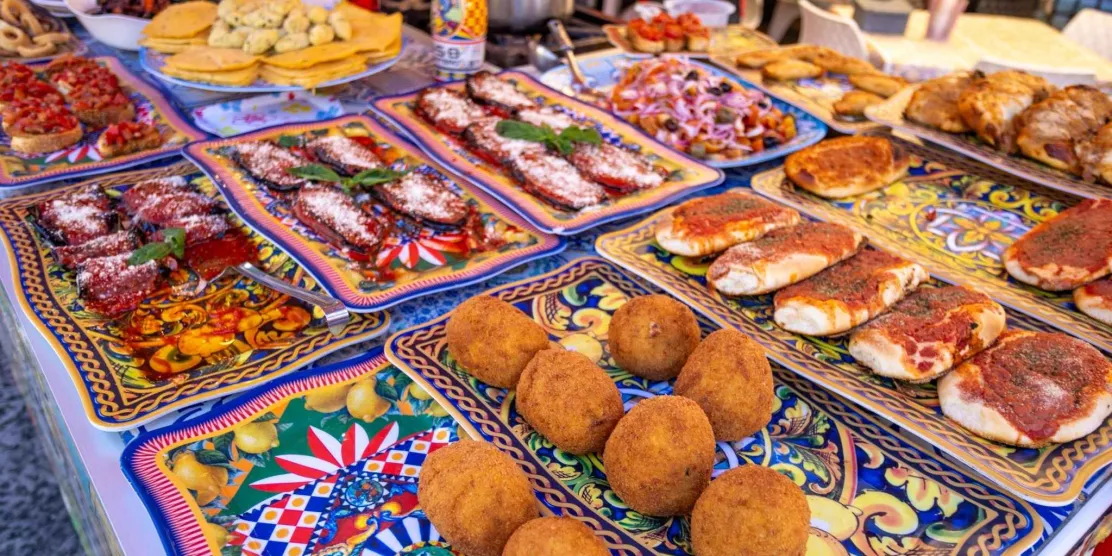
Sicilian food is loud on purpose. Street markets in Palermo and Catania sell fried seafood, spleen sandwiches and arancini as a matter of course, and the island's cannoli, granita and dolci culture is arguably its most famous export after the temples. Sicilian cooking carries visible layers of Arab, Norman and Spanish influence, especially in its use of citrus, saffron and pine nuts.
Sardinian food is calmer, closer to a farmhouse table. Fregola, a sun-dried pasta similar to couscous, and malloreddus, a shell-shaped gnocchi in tomato and saffron sauce, anchor most menus, alongside culurgiones, ravioli-style parcels filled with pecorino and mint. Seafood from Alghero, porceddu (slow-roasted suckling pig) at inland agriturismi, and Cannonau wine, from the Nuoro province in the mountainous interior, one of the world's five Blue Zones for exceptional longevity, round things out.
Our pick: Sicily for variety and street food energy, Sardinia for a slower, ingredient-led table. Most first-time visitors mention Sicily's food as a highlight even when the beaches weren't; Sardinia's food tends to surprise people who arrived expecting “just good, not exceptional.”
Sicily or Sardinia Nightlife?
Sicily's nightlife concentrates in Palermo and Catania, both university towns with bar scenes that stay busy into the small hours. Palermo's scene spreads out and usually needs a car between spots; Catania packs its bars close enough to walk between. Taormina adds a smarter, cocktail-bar version aimed at holidaymakers rather than locals.
Sardinia's nightlife runs to a different rhythm, concentrated around the Costa Smeralda and Porto Cervo, where clubs like Billionaire, founded by former Formula One boss Flavio Briatore, draw an international, big-spending crowd through the summer. Olbia adds a younger, more affordable scene nearby.
Our pick: Sicily for an everyday night out with locals, at local prices. Sardinia's Costa Smeralda for a glamorous one-off night, budget allowing.
Is Sicily or Sardinia Cheaper?
On average, Sicily tends to be the more affordable island. Cost guides put a budget day in Sicily at roughly €75-170 covering accommodation, food, transport and activities, rising to €185-350 mid-range and €380-820+ at the luxury end, generally cheaper than Rome, Venice or the Amalfi Coast.
Sardinia runs higher overall, with typical daily spend closer to €100-250 per person. The gap widens sharply around the Costa Smeralda, where hotels, restaurants and beach clubs target international luxury travellers specifically. Away from that stretch, in towns like Alghero or inland agriturismi, Sardinia's prices come much closer to Sicily's.
Travel style | Sicily (daily, all-in) | Sardinia (daily, all-in) |
|---|---|---|
Budget traveller | €75-170 | €100-130 |
Mid-range traveller | €185-350 | €180-280 |
Luxury traveller | €380-820+ | €500+ |
Our pick: Sicily if budget drives the decision. Budget-conscious travellers who still want Sardinia often say the fix is simple: avoid the Costa Smeralda and stay inland or around Alghero instead.
Sicily or Sardinia for Families, Couples and Honeymoons
Who you're travelling with changes this comparison more than almost anything else. Here's how the two islands split by group.
Sardinia or Sicily with Kids?
Sicily generally has the edge for families who want variety within a short drive: city sights mixed with beaches, and busy towns where facilities are easy to find. Sardinia works well for families who prioritise calm, shallow beaches and space to spread out, particularly around La Pelosa or the Costa Smeralda's family resorts. Parents commonly mention Sardinia's shallow, current-free coves as easier with younger children than some of Sicily's rockier spots.
Sicily or Sardinia for Couples and Honeymoons?
Sardinia's quieter coves, boutique coastal hotels and slower pace suit a honeymoon built around privacy and scenery. Sicily suits couples who want their romance mixed with cities, food and culture rather than pure seclusion, with Taormina a frequent honeymoon base thanks to its combination of coastline and old town. Honeymooners who've compared notes tend to split along exactly that line: seclusion versus an evening stroll into town.
Best Time to Visit Sicily or Sardinia
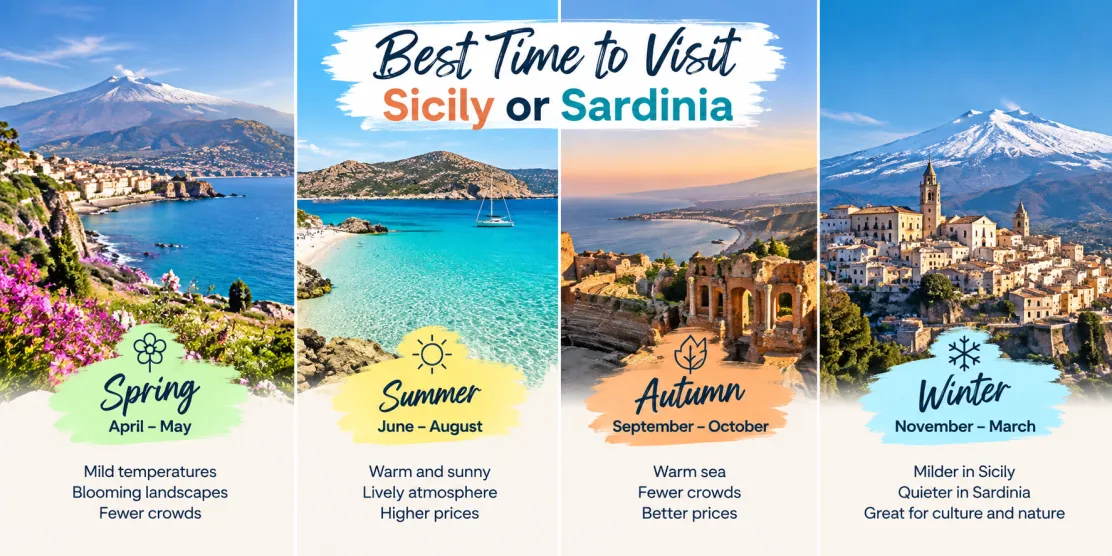
Timing shifts the comparison almost as much as the traveller profile does. Season by season:
Visiting Sicily or Sardinia in Spring?
Spring (April-May) is arguably the strongest window for both islands. Sardinia's hiking trails disappear under wildflowers, Sicily sits comfortably in the low-to-mid 20s°C, and neither island is crowded yet. Repeat visitors often name spring as the season they'd choose if forced to pick just one trip, on either island.
Sicily or Sardinia in Summer (June to August)?
Both islands get busy and expensive in high summer, particularly Sardinia's north coast and Sicily's Aeolian Islands. Heatwaves are common on both, so inland sightseeing is best scheduled for early morning, and coastal accommodation should be booked well ahead. Sicily's cities at least offer air-conditioned museums and shaded old towns as a midday escape; Sardinia in peak summer rewards early bookers, and latecomers commonly report disappointment with what beach space is left.
Sicily or Sardinia in October?
Sea water stays warm into October on both islands, crowds thin out, and prices drop noticeably. Many repeat visitors describe this as the strongest all-round window for either destination.
Sicily or Sardinia in Winter?
Sicily stays livelier through winter thanks to its cities and Mount Etna, which sees snow and draws day-trippers from Catania and Taormina. Sardinia's coastal towns largely shut down outside the main season, which suits a quieter, car-based trip rather than a beach holiday.
How Do You Get from Sicily to Sardinia?
Direct flights connect Palermo with both Cagliari and Olbia in around one hour, operated mainly by Ryanair and Volotea, though only a handful of departures run each week rather than daily. Grimaldi Lines also runs an overnight Palermo-Cagliari ferry roughly once a week, taking around 12 hours and allowing you to bring a car, with fares that vary widely by season and cabin type.
Sicily or Sardinia for a Road Trip?
Sicily's compact size makes it a strong road-trip island: a loop from Palermo through Marsala, Agrigento, Syracuse and Catania and back covers around 740 km and roughly 10 hours of driving, commonly spread across 5 to 7 days with stops along the way.
Sardinia rewards a point-to-point route more than a loop, given its size and mountainous interior. A coast-to-coast drive from Cagliari up through Alghero to the Costa Smeralda covers a comparable distance but trades temple-hopping for long, quiet coastal stretches and detours into the Gallura granite interior.
Our pick: Sicily if you want a road trip packed with stops. Sardinia if you want a road trip that's mostly about the driving itself, between beaches.
Where to Stay in Sicily and Sardinia?
The two islands don't just differ in price, they differ in what kind of stay they're built around.
Sicily's accommodation runs wide rather than deep. In Palermo, converted palazzi and Ortigia's old-town guesthouses put you a walk from the market and the sea in the same breath.
Inland, bagli, fortified Sicilian farm estates originally built for wine and olive production, have been turned into quiet countryside stays with courtyards and their own vineyards.
On the smaller island of Pantelleria, the traditional dammuso, a low, domed stone house built to survive the wind, has become its own kind of destination stay. Taormina sits at the polished end of the spectrum, with hillside boutique hotels overlooking the sea and Etna at once. Sicily's spread of budgets also makes it a strong island for holiday rentals, from a simple Ortigia flat to a countryside baglio with its own pool.
Sardinia's accommodation clusters more sharply. Around the Costa Smeralda, resort hotels and private villas are built for a specific kind of traveller: yacht-adjacent, seasonal, and priced accordingly, with beach clubs functioning almost as an extension of the hotel itself.
Move inland or west and the picture changes fast. Traditional stazzi, granite farmhouses once used by Gallura shepherds, now operate as simple, family-run agriturismi with home-cooked dinners included.
Alghero's old town, with its Catalan-influenced streets, offers a calmer, more walkable base with prices well below the northeast coast around Porto Cervo.
Budget level | Sicily (accommodation, per night) | Sardinia (accommodation, per night) |
|---|---|---|
Budget | €35-80 | €40-80 |
Mid-range | €80-150 | €100-200 |
Luxury | €150-400+ | €300-1,000+ (Costa Smeralda can run higher) |
So, Sicily or Sardinia? Compare and Book With Cozycozy
There's no single answer to Sicily or Sardinia, only a better answer for the trip you're actually planning.
Sicily makes sense when the appeal is density: temples, baroque towns, Mount Etna, street food and a beach, all reachable inside one loop, for a lower average daily spend.
Sardinia makes sense when the appeal is space: long stretches of coastline, quiet coves, and a slower rhythm, at a higher price if the Costa Smeralda is part of the plan.
If this is a first trip to either island and culture, food and easy city-hopping matter most, Sicily is the safer starting point. If the trip is specifically about beaches, seclusion or marking an occasion like a honeymoon, Sardinia earns its reputation.
Doing both properly, rather than rushing four days on each, is the option nearly every repeat visitor recommends once they've tried the alternative.
Whichever island wins, the next step is the same: compare hotels in Sardinia and Sicily side by side and see which prices, and which version of the island, actually fit your trip.
Frequently Asked Questions About Sicily and Sardinia
Which is nicer, Sicily or Sardinia?
Neither is objectively nicer; it depends on priorities. Sicily generally wins on culture, food and affordability, while Sardinia leads on beaches, scenery and quiet. Most travellers end up favouring whichever matches what they went looking for.
Is Sardinia or Sicily more expensive?
Sardinia tends to run more expensive overall, particularly around the Costa Smeralda, where hotels and restaurants target luxury travellers. Sicily is generally the more budget-friendly island, with costs closer to other southern Italian destinations.
What is the prettiest Italian island?
Beyond Sicily and Sardinia, Italy has other strong contenders, including Capri and the Aeolian Islands (technically part of Sicily). For beach scenery specifically, Sardinia is the island most consistently ranked among the Mediterranean's best; for varied, dramatic landscapes, Sicily holds its own with Mount Etna and its coastline.
Sicily, Sardinia or Corsica?
Corsica is the third major island in this part of the Mediterranean, French rather than Italian, and closer in feel to Sardinia than to Sicily: dramatic granite coastlines, quieter towns, and a similarly high price level, especially around Porto-Vecchio and Calvi. If culture and cities matter most, Sicily still stands apart from both. For a beaches-and-scenery choice between Sardinia and Corsica specifically, the two are close enough, and the ferry crossing between Sardinia's Santa Teresa di Gallura and Corsica's Bonifacio is short, that combining them in one trip is realistic.


