

Discover what a capsule hotel is, how much it costs, and where to find real examples in Japan and beyond, from Tokyo to London.
In 1979, a sauna operator in Osaka built a room made almost entirely of stacked plastic boxes, each one barely bigger than the bed inside it.
That room became the Capsule Inn Osaka, the world's first capsule hotel, and the idea has since spread from Japanese train stations to London's Piccadilly Circus. So what is a capsule hotel, exactly, and is it something you'd actually enjoy?
This guide covers what's inside, what it costs, who it suits, and how to book one, including a growing list of hotels in Tokyo worth comparing before you decide.
What Is a Capsule Hotel? Quick answer
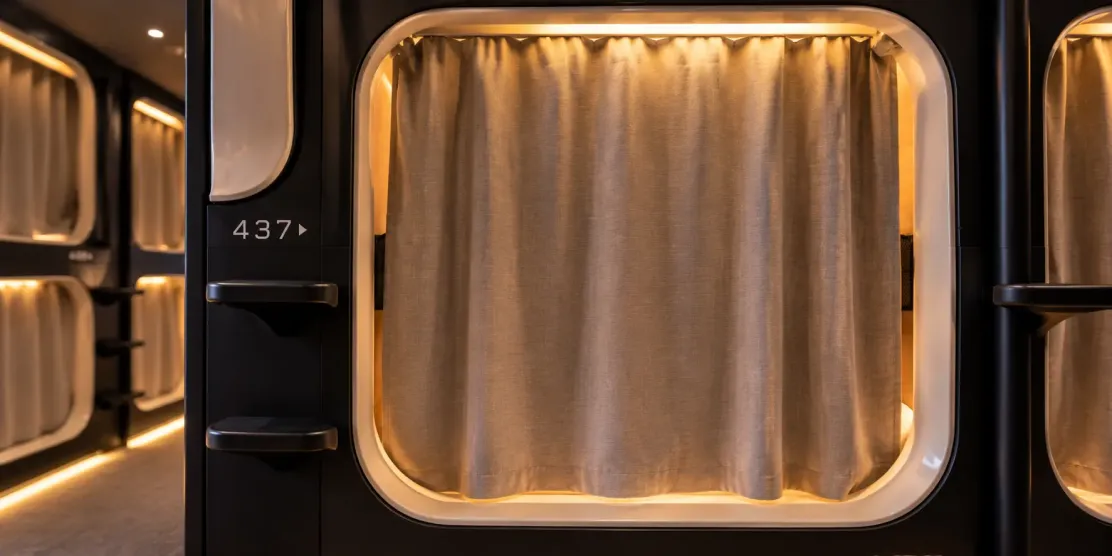
A capsule hotel is a type of budget accommodation made up of dozens, sometimes hundreds, of individual sleeping pods rather than traditional rooms. Each capsule is roughly the size and shape of a single bed, just tall enough to sit up in, and it comes fitted with a mattress, bedding, a reading light and a power socket. A curtain or a sliding door closes off the opening for privacy, though in Japan the door cannot be locked from the inside, which is a legal safety requirement rather than an oversight.
Capsules are stacked two units high and arranged in long rows, a little like a corridor of bunk beds turned sideways. Everything else, bathrooms, showers, lounges and luggage storage, is shared.
It's a format built around one idea: strip a hotel room down to the essentials, and pass the savings on space straight on to the guest.
What Is a Japanese Capsule Hotel? The Origins Explained
The concept was dreamed up by Yukio Nakano, who ran a sauna in Osaka and kept noticing customers who had missed the last train home and had nowhere better to sleep than his sauna floor.
He asked architect Kisho Kurokawa, who had already exhibited a similar pod-based housing concept at the 1970 Osaka World Expo, to design something purpose-built. The result, Capsule Inn Osaka, opened its doors in the city's Umeda district in 1979 and set the template that every capsule hotel since has followed in some form.
What started as a practical fix for Japan's famously long working hours has since travelled far beyond its original audience. The format has been adapted, resized and reinterpreted in cities from Reykjavik to Hong Kong, though its DNA still traces straight back to that first Osaka sauna problem.
What's It Actually Like Inside a Capsule Hotel?
What Does a Capsule Hotel Room Look Like?
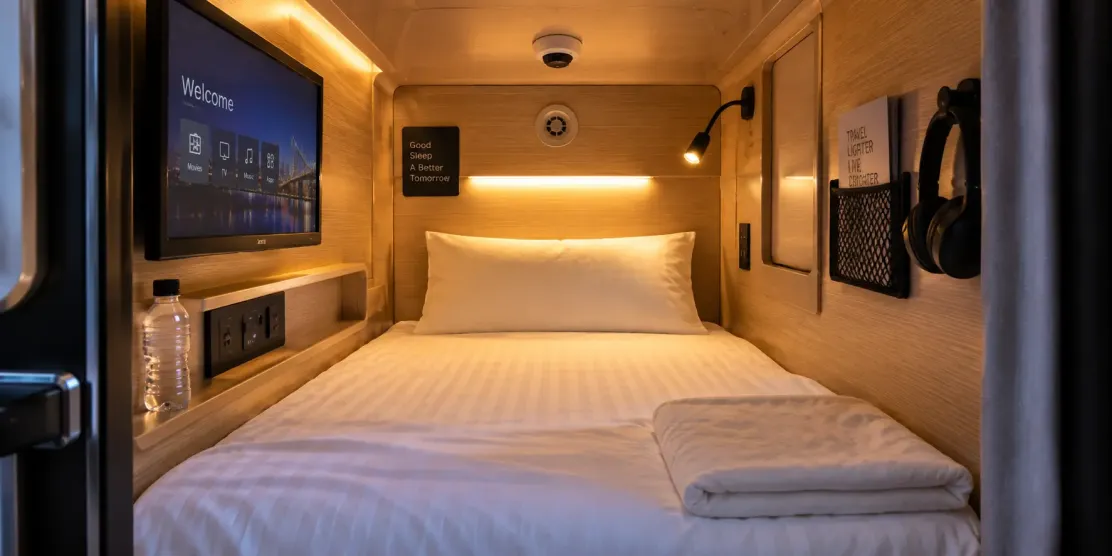
A standard capsule measures roughly 1.2 metres wide, 2 metres long and 1 metre high, just enough room to lie down, sit up and change comfortably, but not to stand.
Inside, expect a firm single mattress, a pillow and blanket, a small shelf, a reading light, a power socket and usually a television built into the wall.
Higher-end pod hotels stretch these dimensions considerably, some closer to the size of a small single room, with proper air conditioning and a bed frame rather than a mattress on a shelf.
Do Capsule Hotels Have Bathrooms?
No capsule has its own bathroom. Toilets are found at the end of each corridor, and showers are almost always communal, often set up as traditional Japanese-style bathing areas where you rinse off while seated before soaking in a shared tub. Soap, shampoo and towels are typically provided. Since your capsule doesn't lock, valuables go in an assigned locker rather than staying with you overnight.
Where do you put your luggage in a capsule hotel?
Your assigned locker is built for a phone, a small bag and a few personal items, not a full suitcase. Larger luggage almost always needs to go into a dedicated luggage room or be checked at the front desk, so it's worth asking about size limits when you book. A small padlock of your own adds an extra layer of reassurance, since not every locker comes with one included.
How Private Is a Capsule Hotel? Noise and Etiquette
Capsule hotels run on a quiet, considerate code rather than strict rules.
Guests are generally asked not to eat, smoke or make calls inside their capsule, and most people wear the provided slippers and change into a simple robe or nightwear once inside. Because the walls between capsules don't reach the ceiling, sound travels more than in a standard hotel room, so a lighter sleeper might want earplugs on hand.
Most properties are also gender-segregated, either by separate floors, separate buildings, or women-only sections, which is worth checking before you book.
Is a capsule hotel safe?
Yes, generally. Most capsule hotels staff a front desk around the clock, and access to the sleeping floors is usually restricted by keycard or PIN to registered guests only, which keeps the corridors secure even though individual capsule doors can't lock from the inside. Established chains reinforce this further with dedicated women-only floors or buildings, and lockers for anything you don't want left out overnight. As with any shared accommodation, it still pays to book a well reviewed, well known property rather than the cheapest unnamed option you can find.
How Much Does a Capsule Hotel Cost?
Price is still the single biggest reason people choose a capsule hotel over a conventional room, and the gap can be significant.
In Japan, a standard capsule typically costs somewhere between 2,000 and 5,000 yen a night, roughly £9 to £24, though city-centre locations and peak travel seasons push that towards the higher end.
Outside Japan, prices vary far more widely depending on the market and how premium the brand is.
Location | Typical style | Approximate price per night |
Osaka or Tokyo, standard capsule | Basic pod, shared bathroom | £9 to £24 |
Tokyo, premium or themed pod | Larger capsule, extra amenities | £30 to £60 |
London, Zedwell Piccadilly Circus | Windowless soundproofed pod | From around £30 |
London, airport pod hotels | Compact ensuite cabin | Priced per stay, often bookable in short blocks |
New York or Singapore, pod-style hotel | Compact cabin with private bathroom | Priced closer to a standard budget hotel room |
As a rule, the more a pod hotel resembles a boutique product, with its own bathroom, proper bed frame and design flourishes, the closer the price creeps towards a normal budget hotel room.
The classic Japanese capsule, bare-bones and shared, remains the cheapest version of the concept by a wide margin.
What Is the Point of a Capsule Hotel? Who It Suits
Who should stay in a capsule hotel
A capsule hotel earns its keep in exactly the situations where a normal hotel room feels like overkill. If you're catching a 6am shinkansen and don't want to pay for a full night you'll barely use, a capsule near the station lets you rest for a few hours and go.
- Solo travellers on a tight budget get a private, lockable-enough space for a fraction of the price of even the cheapest standard room.
- Backpackers and digital nomads who mainly need a clean bed, fast Wi-Fi and a power socket rarely miss the extra square metres.
- Business travellers between meetings or ahead of a late flight get a quiet place to reset without booking a full room.
- Festival-goers and anyone on a tight overnight layover just need somewhere reliable to crash for a few hours.
- Curious visitors who want to experience a genuinely Japanese format at least once during their trip, even for a single night.
Who should think twice
You're seriously claustrophobic, since the enclosed capsule and shared corridor layout won't suit everyone, however cosy the marketing photos make it look.
Families travelling with young children will also find most capsule hotels impractical, since nearly all of them enforce an adults-only or teens-and-up policy.
And if you value total silence or a private bathroom above almost everything else, a capsule hotel is likely to frustrate rather than delight you, at least at the traditional end of the market.
How to Book a Capsule Hotel in Japan and Abroad
Booking a capsule hotel is straightforward once you know what to check first. Here's how to go about it, step by step.
- Decide which style you want. A traditional Japanese pod (bare-bones, shared bathroom, very cheap) and an international "pod hotel" (private ensuite, design-led, priced closer to a normal budget room) are different products, so start by deciding which experience you're actually after.
- Check the gender and age policy. Confirm whether the property is male-only, female-only, mixed by floor, or fully mixed, and check the minimum age, since most capsule hotels don't accept children.
- Confirm the stay-length rules. Some properties cap bookings at a handful of consecutive nights, while others offer weekly or monthly rates for longer stays, so check this before you commit if you're not just booking one night.
- Compare and book. Book directly through the hotel's own site for chains with an app or loyalty programme, or compare several properties at once, including capsule and pod-style stays alongside standard hotels in Tokyo, to see the full range of prices for your dates.
- Plan for your luggage in advance. If you're travelling with more than a small bag, check the locker size or luggage room availability before you arrive, rather than finding out at check-in.
- Check in. Many capsule hotels, particularly larger chains, now use self-service kiosks rather than a staffed desk, so have your booking confirmation and ID ready to move things along quickly.
Capsule Hotels in Japan: Real Examples to Know
- Nine Hours: one of Japan's best-known chains, with several locations across Tokyo, including a branch connected directly to Narita Airport's Terminal 2, ideal for a short layover or an early flight.
- First Cabin: offers noticeably larger capsules designed to mimic a first-class airline cabin, a popular choice for travellers who want the format without feeling quite so boxed in.
- Women-only options: the Nine Hours Kanda branch near Tokyo Station, plus Nadeshiko and Akihabara Bay Hotel, are established, well-reviewed choices for solo female travellers.
- Where to look outside Tokyo: Osaka's Namba district and Kyoto's Kawaramachi area both concentrate a high number of capsule hotels around their main stations.
Capsule Hotels Outside Japan: London, New York and Singapore
- Zedwell Piccadilly Circus (London): billed by its owners as the world's largest capsule hotel, with more than 1,000 windowless, soundproofed pods inside a Grade II-listed building, with rates starting from around £30 a night.
- St Christopher's Inn London Bridge (London): brought a more traditionally Japanese-style capsule setup to the UK in 2018, with curtained pods fitted with charging points and mood lighting.
- Yotel (London, New York, Amsterdam, Singapore): takes the concept in a different direction, drawing on first-class airline cabin design, with both city-centre hotels and dedicated airport properties at London Gatwick, Amsterdam Schiphol and Singapore Changi.
- Pod Hotels (New York): a long-running Manhattan brand applying the pod logic to small, ensuite cabin-style rooms in some of the city's most expensive postcodes.
- The Pod Boutique Capsule Hotel (Singapore): a well-reviewed, independently run capsule hotel near the Central Business District and Haji Lane, offering a more sociable, hostel-like version of the format with segregated pods and private lockers.
Ready to Book Your Capsule Hotel Stay with cozycozy?
Whether you're chasing the novelty of sleeping in a genuine Japanese pod or just need a cheap bed near the airport for a few hours, capsule hotels earn their popularity through sheer practicality. They won't suit every traveller, but for solo trips, tight layovers and budget-conscious city breaks, few formats offer this much convenience for so little outlay. Once you know what to expect, from the shared bathrooms to the locker size, the only real decision left is where to stay.
That's exactly where cozycozy comes in: compare capsule, pod and standard hotels in Tokyo side by side, check today's prices, and book the stay that actually fits your trip.
FAQ: What is a Capsule Hotel
Do capsule hotels exist in the US?
Yes. New York is the clearest example, home to both the Pod Hotels brand and a Yotel property in Times Square, both offering a compact, cabin-style take on the format rather than the bare-bones Japanese original.
Do capsule hotels have bathrooms?
Not inside the capsule itself. Toilets and showers are almost always shared, typically found at the end of each corridor or floor, though some premium pod hotels outside Japan now build a small private bathroom into each unit.
Is a capsule hotel safe for solo female travellers?
Generally, yes. Most capsule hotels are gender-segregated by floor, building or dedicated women-only sections, and established chains such as Nine Hours run several female-only branches specifically for this reason, though it's worth confirming the exact set-up before booking.


